Experiment
Teaching Inkling-2 Small to Drive a Real Car with RL in Simulation
We trained Inkling-2-Small with reinforcement learning on Tinker, entirely in simulated driving environments. Evaluated zero-shot on the real course, the trained model averaged 69% completion in single attempts. The base model reached only 8%, even with three ICL attempts. Of the frontier models we benchmarked on the same course, only Gemini 4 Carbon did better, and only with three ICL attempts.
 Open in Colab
Inkling-2-Small on Tinker · 20 November
DrivingBench v2 frontier models · same course
Reference
Figure 1. On average, the trained model's first attempts went further than any frontier model's; only Gemini 4 Carbon did better, and only with three ICL attempts. Progress on Course A of DrivingBench v2 is the share of the course passed before a cone, a boundary or the finish. Bars are means and dots are single trials; first attempt is a conversation's first attempt and best of 3 the furthest of its three ICL attempts. The trained model made three independent single attempts on 20 November, so it has no best of 3. The base model and the frontier models drove three conversations each, the frontier models in their own agent apps; the human baseline drove one.
Contents
1Why driving is hard for a model
A model gets a cone course in an empty parking lot and three tools: observe returns a frame from the windshield camera and the car's state, set_motion steers and drives for a few seconds, and stop_now stops. They control a Tesla Model 3 through a comma device1, with a safety driver in the seat.
Here is the Inkling-2-Small base model driving a simulated warm-up course with one gentle bend:
- Let me start by observing the scene to understand where I am.
- 3.9 s
observeheld · 0.0 m/s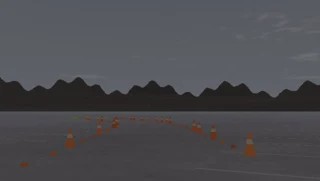
- 4.1 s while the model thinks
- I see a cone course. The cones appear to start a bit ahead of me, curving to the right maybe.
- 8.0 s
set_motionstraight · 1.0 m/s · 6 saccepted - 7.7 s while the model thinks
- 15.7 s
observeheld · 0.0 m/s - 3.7 s while the model thinks
- I notice I didn't actually move? Speed 0, state "held", remaining 0.
- 19.4 s
set_motionstraight · 6 sacceptedContinue straight into the course entrance… - 2.9 s while the model thinks
- 22.3 s
observeexecuting · 1.4 m/s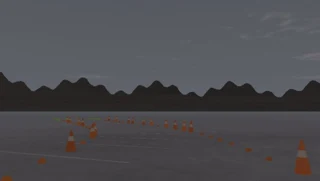
- 8.0 s while the model thinks
- Still moving (stopping). The course: I see the left cone line goes from bottom-left toward the green far…
- 30.3 s
set_motionleft · 5 sacceptedCorridor ahead appears to bend toward the green…
The model sees the cones, notices the bend and decides to steer. But its steer lands 22 s after it set off, and it hits a cone 22% of the way round. On the real course it does the same: its nine attempts there end in the first bend, at 1–10%. That is the core problem: on the real car, chat models take a median of 3.8–5.7 s between tool calls, so at walking pace they drive several meters blind every turn, through cones 1.5–3 m apart.
2The simulator
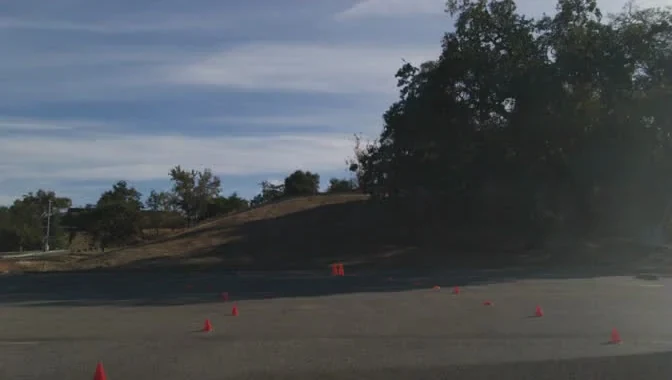
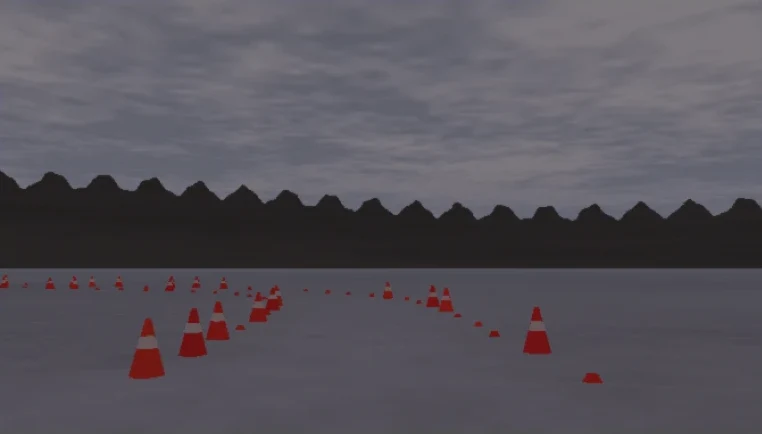
To train efficiently with RL, we built a simulator of the task and trained there. The simulator is deliberately not photorealistic (Figure 2). It is built to be cheap to run and to model time and the car's physics accurately. The car keeps driving on its last command while the model thinks, for exactly as long as a model of that length would think. The simulation runs on a CPU in numpy, and sampling and training run on Tinker2. The code is in this notebook, which runs with your own Tinker key.
a Real car, windshield camera
b Training simulator, same camera mount
c One simulated drive on a gentle course
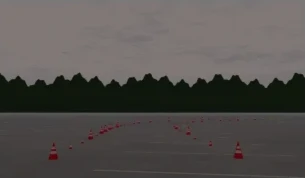 t = 0 s
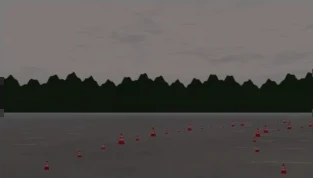 t = 41 s
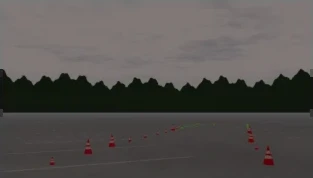 t = 83 s
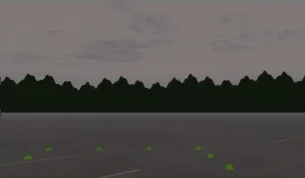 t = 124 s
Figure 2. The simulator is deliberately not photorealistic. (a) The real car's windshield camera on Course A. (b) The training simulator from the same camera mount: a ray-cast asphalt plane, cones drawn as simple shapes over their shadows, a sawtooth skyline and a painted sky, with colours, textures and lighting drawn per episode (Appendix A). (c) Four moments of one simulated drive on a gentle course. Training never sees the real lot or anything photoreal.
The car is fitted; the world is generated. We logged the Tesla at 100 Hz and fitted every stage between a command and the road. On a held-out day of real driving, the fitted car's position is off by a median of 0.29 m over 10-second windows. Courses, scenes and lighting are drawn from seeds, so the real course never appears in training (Appendix A).
Every turn costs time. A model turn that generates tokens takes
the spread we measured on the real car, and the frame observe returns is as old as a real one. The car continues driving on its latest command.
2.1Difficulty levels
To teach the model effectively during RL, we generate courses at ten levels of increasing difficulty (Figure 3). Level by level, the tightest turn tightens from a 26 m to a 6.5 m radius, the course gets longer and narrower, and some cones go missing from the barriers. Each course is generated from a seed: random straights and arcs, joined by smooth transitions, until it is long enough for its level, with one turn at the level's tightest radius; a course is kept only if a perfect driver with no latency can finish it (Appendix A).
Figure 3. Courses get longer, narrower and tighter with each level. The first of the eight held-out evaluation courses at each of the ten levels, all drawn at one scale (bar: 20 m). The car starts at the dot; dotted lines are the two cone rows and the green box is the finish bay. Each course has one turn at its level's tightest radius.
2.2Scoring
Progress is the share of 1 m gates passed, in order. Touching a cone or leaving the lane ends the drive; stopping in the green bay at the end finishes it. The reward is
where is the average speed over the whole drive, thinking time included. The model earns reward for progress, a bonus for finishing, and up to half that bonus again for finishing fast, in full at an average of 0.3 m/s. The speed bonus counts only on a finish, so a fast crash earns nothing extra.
3Training
3.1Group-relative RL
Each step samples 16 groups of 16 rollouts (256 episodes), with course, car and scene fixed within a group, and uses mean-centered group-relative advantages,
optimized with Tinker's stable_reinforce loss3. Groups whose 16 rewards are identical are dropped. Episodes end on reaching the finish, hitting a cone, leaving the lane, or reaching 150 turns or a full 65,536-token context.
The policy is Inkling-2-Small with a rank-32 LoRA, trained using Tinker. Training is asynchronous and at most one step off-policy: each step takes the first 16 groups with a nonzero advantage.
3.2Adaptive curriculum
A group only carries signal when its rollouts have non-constant reward, so we use a curriculum that tracks a level , starting at 1, and samples each group's level around it at rollout start:
Only groups drawn at vote, about three a step, in windows of 8 taken in draw order. With mean progress and finish rate over a window:
This keeps training at the edge of what the model can do. Windows close in draw order, not report order, because early reports are biased toward fast crashes. The curriculum steers on progress rather than finishes, which arrive too late to steer by.
3.3The run
We trained at a constant learning rate of 1e-4, with no KL penalty and 2,048 tokens a turn, and took the checkpoint at step 350, after about 90,000 episodes, as our trained model.
Figure 4. Held-out performance rose as the curriculum moved up. (a) Every 10 steps the policy drove 80 held-out courses, eight per level: the share it finished (solid) rose from 1% at step 0 to 86% at step 350, and its mean progress along the course (dashed) from 22% to 92%. (b) The mean level of the courses each step trained on, smoothed over 9 steps, rose from about 2 to about 9. The dotted line marks step 350, the checkpoint we use as the trained model.
Every 10 steps we evaluated on 80 held-out courses, eight per level. Finishes stayed near zero for 50 steps, then climbed with the curriculum to 86% finished and 92% mean progress at step 350. Levels 1 to 5 were solved; level 10, with a near-full-lock U-turn on every course, finished 38%.
4Results
4.1On the real car
On 20 November we drove the trained model and the base model on Course A, the DrivingBench v2 layout. The trained model made three independent single attempts and reached 76%, 53% and 78% of the course. The base model, given three ICL attempts per conversation like the frontier models in v2, got no further than 7%, 8% and 10%, all in the first bend (Figure 1).
A small model trained only on painted cones thus beats every frontier model's average first attempt, and every best-of-three average except Gemini 4 Carbon's (in Antigravity). A person driving through the same three tools reached 73% on their first attempt.
- Base model, first attempts (5–7%)
- Trained model, 78%
- Trained model, 76%
- Trained model, 53%
Figure 5. Two of the trained model's three attempts reached the late U-turn; the base model's first attempts ended in the first bend. Course A from above, with the v2 survey of its cone rows (grey dots) and the finish bay (green). Coloured lines are the trained model's three single attempts, which reached 78%, 76% and 53% of the course; grey lines are the base model's three first attempts (5–7%). Each track ends where its attempt ended. Tracks are smoothed GPS, good to a meter or two, shifted by at most 2.2 m to fit the cone survey.
Figure 6. The trained model's furthest attempt (78% of the course) from the car's road camera: 13 min 44 s of driving at 12× speed, ending at the late U-turn short of the finish.
Two of the three attempts ended at the late left U-turn. In one, the trained model steered right into the cones halfway round, after reasoning that reads like it had lost track of which cone row it was following: "cone to left of frame probably our lane right/left? good move right into our lane." Replayed fifteen times from that moment, it chose left twelve times and right three: not a consistent mistake, but a coin flip on an ambiguous view.
4.2A photoreal twin of the course
Could a simulator have predicted the car runs? We reconstructed the course as a Gaussian splat4 from the car's camera frames and drove the base model and the trained model through it 32 times each, with the same car, latencies and start. Training never saw this course or anything photoreal.
Figure 7. The photoreal twin ranked the two models as the real course did, by about the same margin. Course progress of each drive: small dots are the 32 twin drives per model, rings are the real-course attempts (the base model's three first attempts, the trained model's three single attempts), and the shaded bar and tick mark the mean. Dotted lines mark the tight right turn and the U-turn; the right-hand column counts the drives that got past the tight right turn.
Roughly, yes. The base model averaged 17% in the twin and 6% on the car; the trained model averaged 75% and 69%. It cleared the tight right turn in 27 of 32 twin drives and in all three real attempts, and most of those twin drives then ended at the same late U-turn as two of the real ones. Three real attempts per model make this a correlation, not a validation, but it suggests a cheap splat can say something about how a model will drive the real course.
Figure 8. The trained model's only finish in its 32 twin drives: 9 min 14 s of simulated driving at 12× speed, road camera beside an overhead map (the overlay's "4×" is the original replay speed).
5Conclusion
We found that a basic simulator that gets the clock right was enough to teach a small model to drive a real car better than much larger models manage on their first attempt. The simulator's painted cones look nothing like the real lot, yet the policy transferred. This suggests a VLM's pretraining may already bridge much of the visual sim-to-real gap, so a simulator's main role is to get the dynamics and the timing right.
Thank you to Thinking Machines for the Tinker credits that supported this work.
Notes
- 1A comma four on the windshield, connected to the car's CAN bus, runs openpilot. The harness turns each tool call into a command for it, and its camera frames and telemetry come back to the model.
- 2Tinker is Thinking Machines' training API. The environment, the curriculum and the data are ours and run on our own machine, in the Tinker cookbook's training loop; sampling, the forward and backward passes, the LoRA weights and the checkpoints run on Tinker.
- 3A policy-gradient loss that stays stable when the sampler and the trainer disagree slightly about token probabilities, using what the sampler recorded about each sequence it sampled.
- 4A 3D reconstruction of the real lot, built from camera frames of it, that renders the camera's view from any pose.
- 5A renderer turns a conversation into the tokens the model reads and parses what the model writes back into messages.
tml_v0is the one the Tinker cookbook recommends for Inkling models.
ASimulator details
A.1Fitting the car
A set_motion command passes through our controller, openpilot's controls, Tesla's safety limits, the power steering and the motor. At the speeds we drive, walking pace to a jog, it collapses to a proportional speed controller with a jerk limit, Tesla's 250°/s cap on the steering target, two delayed first-order lags and a bicycle model. The simulator runs our controller and openpilot's controls as they run on the comma, tick for tick at 100 Hz, from the same code. Only the car below them is fitted, and it is one short step in sim/plant.py:
p, dt = self.p, self.dt
self.accel_queue.append(accel_cmd if long_active else 0.0)
delayed = self.accel_queue.popleft()
if self.standstill:
    self.accel = 0.0
    self.waiting_s = self.waiting_s + dt if long_active and delayed > 0 else 0.0
    if self.waiting_s >= p.launch_s - dt / 2:
        self.speed, self.accel = 1e-3, p.launch_accel_mps2
else:
    self.accel = float(accel_step(p, self.accel, delayed, dt))
    self.speed = max(0.0, self.speed + self.accel * dt)
    self.waiting_s = 0.0
# The EPAS follows the applied angle only while openpilot steers; otherwise it holds.
self.steer_queue.append(angle_cmd if lat_active else self.steer_deg)
target = self.steer_queue.popleft()
previous = self.steer_deg
if lat_active:
    self.steer_deg = float(steer_step(p, self.steer_deg, target, dt))
self.steer_rate = (self.steer_deg - previous) / dt
angle = math.radians(self.steer_deg - self.offset)
yaw_rate = p.yaw_scale * self.speed * self.curvature(angle, self.speed)
self.heading += yaw_rate * dt
self.x += self.speed * math.cos(self.heading) * dt
self.y += self.speed * math.sin(self.heading) * dt
The fitted constants are small: a 0.1 s delay and a 0.1 s lag on acceleration, a 0.04 s delay and a 0.1 s lag on the wheel, a 0.19 s wait before the car pulls away, and a car that turns 2% tighter than the bicycle model says.
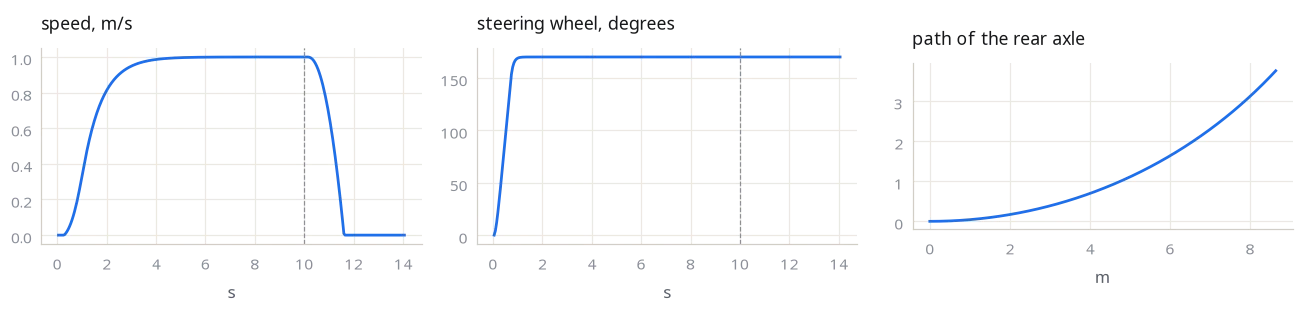
Figure 9. The fitted car's response to one command, set_motion("left", 50, 1.0, 10): speed (left), steering-wheel angle (middle) and the path of the rear axle (right). The wheel reaches its angle in under a second and the car 1 m/s within about 4 s; when the command expires at 10 s (dashed line), the car brakes to a stop over about a meter.
On a held-out day of real driving (2,402 windows of 10 s, median absolute error), the fitted car is off by 0.032 m/s, 0.33° at the wheel and 0.29 m in position. That check covers the car below openpilot, not our controller on top of it.
A.2Generating courses
A course is a centerline built from curvature as a function of distance: straights, arcs and clothoid ramps between them, so the steering never has to change faster than the car can turn the wheel. Turns are added until the course is long enough for its level, each at a radius drawn log-uniform from the level's tightest to 30 m, mostly alternating left and right. Then one of them, drawn at random, becomes the level's test turn: the tightest radius, through the top quarter of the level's arcs.
radius = least * (30 / least) ** rng.random()  # log-uniform to 30 m
sign = -sign if rng.random() < 0.6 else sign
arc = math.radians(rng.uniform(d.min_turn_deg, d.max_turn_deg))
straight = rng.uniform(3, 15) if rng.random() < 0.65 else 0.0  # else reverse straight in
turns.append((sign / radius, arc, straight))
A turn that would take the heading more than 190° from the start's turns the other way instead, so after a U-turn a course snakes back rather than spiralling into itself. Two rows of cones follow the line, 1.5–3 m apart, and a bay of green domes is the finish. A course is kept only if a no-latency autopilot can finish it on the nominal car.
A.3The camera
We ray-cast a flat asphalt plane, a sky and a skyline of trees or buildings, and paint the cones as small frustums over their shadows, from the real mount: 1.24 m up, pitched 4.6° up and turned 1.8° right. Everything else about the look is drawn from a seed, so the model cannot latch onto any of it.
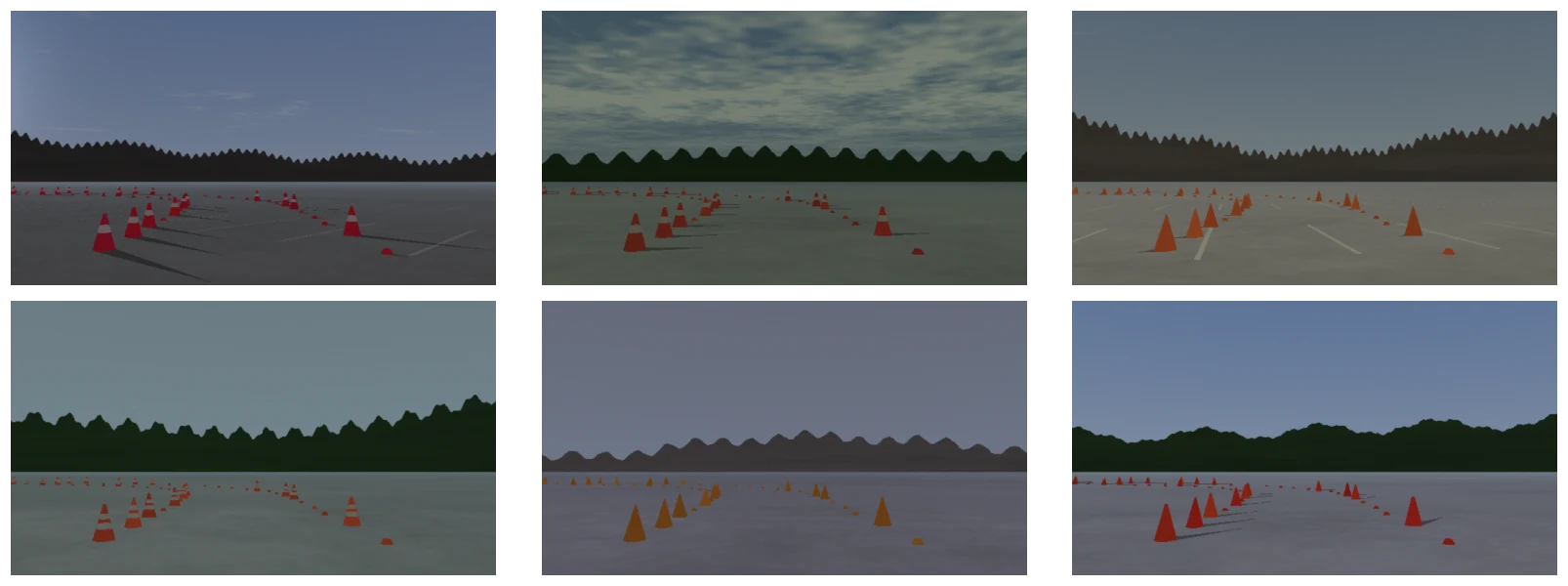
Figure 10. One moment of one course under six scene seeds. Cone colour, asphalt, sky, skyline and parking stripes are all drawn per episode, so the policy cannot rely on any one look.
A.4Latency and noise
Each tool call adds 100 ms, and the age of observe's image is drawn from 8,477 real observes (median 0.58 s, sometimes over 2 s). Every episode also gets a slightly different car: delays and lags ±20%, steering rate ±15%, motor gain ±5%, steering ratio ±3%, how tightly it turns for a wheel angle ±5%, a camera off by up to 1° and 4 cm, and a wheel offset of up to ±3° that the controller doesn't know about, so "straight" curves a little. A quarter of episodes keep the fitted values exactly.
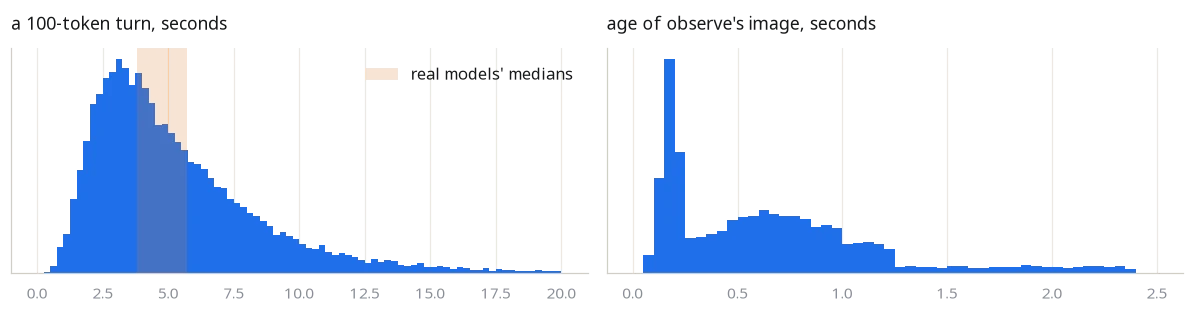
Figure 11. The two delays the simulator draws on every turn. Left: the duration of a 100-token turn, 4.5 s at the median and over 9.7 s one time in ten; the shaded band spans real chat models' median turn times on the car. Right: the age of observe's image, drawn from 8,477 real observes, 0.58 s at the median.
A.5A perfect driver with a model's latency
How much does the clock alone cost? The notebook's tools_oracle knows the course exactly and plans from where the car will be when its command lands, but it thinks with a model's latency and drives through the same three tools, always at 0.8 m/s for 5 s. It finishes 68% of level-1 courses, 45% at level 3, 5% at level 5 and none above. With the same knowledge and no latency, oracle finishes every layout the generator draws through level 8, 97% at level 9 and 81% at level 10; layouts it can't finish are discarded, so every training course can be driven. The tail does the damage: one turn in ten takes over 9.7 s, nearly 5 m at a crawl.
Figure 12. Latency alone makes the generated courses hard, even for a driver that knows them exactly. Share of 40 generated courses finished at each level by two such drivers. With no latency (grey), oracle finishes every course through level 8, 97% at level 9 and 81% at level 10. With a model's latency, driving through the same three tools (blue), tools_oracle finishes 68% at level 1 and none from level 6 on.
tools_oracle is a floor, not a ceiling: it never slows down or stops to look again. A model that learns to do either can beat it.
A.6One episode, one sequence
Each turn is recorded as the cookbook's Transition, and trajectory_to_data packs an episode into one training sequence, the advantage on the model's tokens and zero on the prompt, tool results and images. One wrinkle: the tml_v0 renderer5 writes a tool call's arguments back with sorted keys, so a call the model wrote in another order no longer extends the last prompt, and trajectory_to_data starts a second sequence there. The loss still sees exactly the sampled tokens.
BWhat it learned
We can see what RL changed by comparing how the trained model and the base model drive the twin, on the same 32 seeds.
| On the photoreal twin, 32 drives each | Base model | Trained model |
|---|---|---|
| Tokens per turn, median | 68 | 20 |
| Tokens per turn, longest | 1,992 | 209 |
| Commands steering past 60% of full lock | 1.5% | 19.5% |
| Typical command, speed and duration (median) | 1.0 m/s, 8 s | 0.8 m/s, 5 s |
| Turns per drive, mean | 13 | 101 |
Figure 13. RL changed how the model drives, not only how far it gets. The trained model and the base model on the same 32 photoreal-twin seeds: the trained model writes far shorter turns, steers hard more often, moves in shorter commands and takes about eight times as many turns per drive.
It thinks in a sentence. The base model writes a median of 68 tokens a turn and once nearly two thousand; the trained model writes 20, and never more than about 200: "Cone directly ahead maybe maybe cone in our path; must move left sharply. left 90/95." Every token is time the car spends on its last command.
It steers hard. One command in five from the trained model asks for more than 60% of full lock; the base model almost never does. That is what the levels were built to teach: every course holds one turn at its level's tightest radius, up to 91% of full lock.
It moves in short, even steps. Every command is 5 s, usually at 0.8 m/s: about 4 m, then a new look. The base model drives 1 m/s for 8 s at a time. On the real car, the trained model kept the same rhythm.
It takes many small decisions. A drive by the trained model is about a hundred turns where the base model's is thirteen, many of them a quick look with a few words of thought. Short turns keep the frame it acts on fresh.
Citation
Please cite this work as:
@misc{drivingbench2026inkling,
  title  = {Teaching Inkling-2 Small to Drive a Real Car with RL in Simulation},
  author = {Aditya Ramabadran and Simon Mahns and Tobias Gessler},
  year   = {2026},
  url    = {https://drivingbench.com/blog/inkling-rl/},
}